A student who has passed with at least 40% marks in the Higher Secondary Examination (10+2) of CBSE or an equivalent examination (10+2) recognized as such by the university (with five papers including English as compulsory subject), shall be eligible for admission into the 1st semester of the
6th semester Degree Course in Arts in semester system. Student passed out from National Open School are also entitled to get Admission.
DOCUMENTS REQUIRED WHILE FILLING UP OF UNIVERSITY EXAMINATION FORMS
a) College Identity Card.
b) University Registration Card – Original and 2 Xerox copies.
c) Recent passport size photograph – 3 (Three copies) with name and class written on the backside.
d) Class – X pass certificate – Original with 2 Xerox copies.
e) Class – XII marksheet – Original with 2 Xerox copies.
f) ST Certificate for APST students – 2 Xerox copies.
g) AB ID – 2 Xerox copies.
h) B.A Ist & IInd semester marksheet – Original with 2 Xerox copies. (For B.A IIIrd semester) B.A
Ist, IInd, IIIrd & IVth semester marksheet – Original with 2 Xerox copies. (For Vth semester)
COURSE STRUCTURE
The B.A semester system shall have the following components, viz.
I) Compulsory Courses : These courses are compulsory courses for all the
students in the programme.
ADMISSION IN B.A Ist SEMESTER
Documents required during Admission:
a) Pass certificated of Class – X (Original with 2 Xerox copies)
b) Mark-sheet of Class – XII (Original with 2 Xerox copies)
c) Transfer certificate from the Head of Institution last attended in original.
d) Character certificate from the Head of Institution last attended in original.
e) ST certificate for stipend (Original with 2 Xerox copies).
f) ABC ID (2 Xerox copies)
g) Aadher card (2 Xerox copies)
h) 3 (Three) recent passport size photograph with name and class written on the back side.
The photograph should be in white dress and light background.
COURSE STRUCTURE FOR B.A IST SEMESTER
The curriculum shall be drafted as per the UGC Curriculum and Credit Framework for Undergraduate Programmes 2022 with an aim to equip the students with
knowledge, skill, values, and attitude. The curriculum shall consist of major stream courses, minor stream courses and courses from other disciplines, language courses, skill courses, and a set of courses on environmental education, understanding India, digital and technological solutions, health &wellness, yoga education, and sports and fitness. At the end of the second semester, students can decide either to continue with the chosen major or request achange of major. The minor stream courses will help the students to equip with job- oriented skills. Overall, a 3-Year Degree course consists of two sections – a Core Courses and a Common Courses. While the Core Courses consists of Major and Minor courses, the Common Courses is divided into 5 sub-groups. Major Courses The major courses would provide the opportunity for a student to pursue in-depth study of a particular subject or discipline. Students may be allowed to change major within the broad discipline at the end of the second semester by giving her/him sufficient time to explore courses during the first year. Minor Courses. Students will have the option to choose courses from disciplinary/interdisciplinary minors. Students who take a sufficient number of courses in a discipline or an interdisciplinary area of study other than the chosen major will qualify for a minor in that discipline or in the chosen interdisciplinary area of study. A student may declare the choice of the minor and vocational stream at the end of the second semester, after exploring various course. Multi-Disciplinary Courses (MDC). All UG students are required to undergo 3 introductory-level courses relating to any of the broad disciplines given below. These courses are intended to broaden the intellectual experience and form part of liberal arts and science education. Students are not allowed to choose or repeat courses already undergone at the higher secondary level (12th class) in the proposed major and minor stream under this category. The levels of these courses are of Class XII. These courses will have 9 credit allocation. Ability Enhancement Courses (AEC) Students are required to achieve competency in a Modern Indian Language (MIL) and in the English language with special emphasis on language and communication skills. The courses aim at enabling the students to acquire and demonstrate the core linguistic skills, including critical reading and expository and academic writing skills, that help students articulate their arguments and present their thinking clearly and coherently and recognize the importance of language as a mediator of knowledge and identity.These courses are compulsory and will have 8 credit allocation.
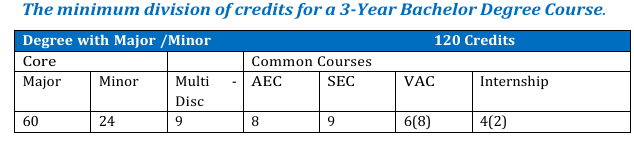
Skill Enhancement Courses (SEC)
These courses are aimed at imparting practical skills, hands-on training, soft skills, etc., to enhance the employability of students. The institution may design courses as per the students’ needs and available institutional resources. These courses arecompulsory and will have 9 credit allocation.
Value Added Courses (VAC)
These courses span over the following four different groups. These courses will have 6 credit allocation.
.Environmental Science
Courses Credits for UG programme.
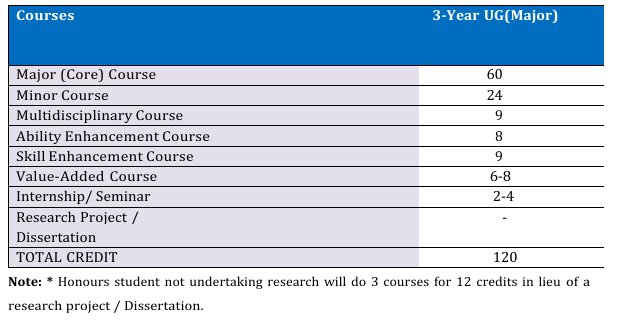
Major Courses:
The courses under major category would provide the opportunity for a student to pursue in-depth study of a particular subject discipline. A student enrolled, has to choose a subject discipline as his/her major from the list of Major Courses approved by the Academic Council of Rajiv Gandhi University. A student has to
secure a minimum of 90 credits in the FYUP as Major courses. These major courses are categorized as follow:
(i) Foundation or introductory courses: These courses are intended the students to gain an understanding and have basic knowledge about the subjects. Students have to study such two such courses in the first year of the programme, one in 1st semester and another in 2nd semester. It will enable students to opt the subject of his/her interest after one year.
(ii) Intermediate-level courses: These are subject-specific courses intended to meet the credit requirements for major areas of learning. These courses are part and pre- requisite courses for advanced-level major courses. A student has to be enrolled in a number of such courses in the 3rd, 4th, 5th and 6th Semesters of his/her study.
(iii) Higher-level courses: These courses are required to get Honours in a particular subject discipline. A Student has to enroll into the Advanced-level courses including research methodology, project/dissertations after successful completion of 6th semester of the programme.